1. Why are some forms of religion called Primal? Describe some of the characteristics of primal religions.
Certain forms of religion are known as Primal, because they were "the traditions of non-literate people." They do not depend on scriptures or written teachings, as many modern religions do (ex: Christianity: The Bible, Islam: The Quran, etc.). Primal religions are passed down orally, from generation to generation through myths and stories. Primal religions are most often the traditions of tribal peoples.
2. What elements of the natural and human world did the Ancestors create or establish in the period of the Dreaming?
During the period of "the Dreaming", the Ancestors createsd the first human beings. They established certain tribes and the customs, social rules, and language of those tribes. They left symbols, found in the forms of rock paintings, rock formations, natural landmarks, etc.
3. What survives in the symbols left behind by the Ancestors?
The spiritual essence of the Ancestors lives on through the symbols that they left behind. The sites in which these symbols are located are considered sacred, and only certain individuals are allowed to visit them. These particular sites must be approached in a special way, as they are thought by the Aboriginies to be "charged with sacred power.".
4. Explain the terms totem and taboo.
The term totem, refers to an animal or natural object considered as being ancestrally related to a given
kin or descent group taken as it's symbol (a symbol, especially one held in high
regard). Taboo is a system of social ordering that dictates that specific objects and activities, owing to their sacred nature, are set aside for specific groups and are strictly forbidden to others; common to many primal peoples, including the Australian Aborigines; a Polynesian language (among some Polynesian peoples, a sacred prohibition put
opon certain people, things or acts which makes them untouchable, unmentionable,
etc.).
5. Why is ritual essential if Aboriginal life is to have meaning?
To Aboriginies, it is only through ritual that the sacred power of the Dreaming can be accessed and experienced. Also, the Aboriginal religion is "the process of recreating the mythic past of the Dreaming in order to tap it's sacred power.".
6. How did Aboriginal rituals originate?
Aboriginal rituals are based on a particular myth that 'tells of certain actions of the Ancestors during the Dreaming.". The rituals originated during the Dreaming, when the Ancestors created certain aspects of the world that we live in today.
7. What purposes are served by Aboriginal initiation rituals?
Aboriginal initiation rituals "awaken young people to this spiritual identity, and redefine their social identity within the tribe.". The initiation rituals also symbolize the death of childhood, and prepares the way for the spiritual rebirth, which is a necessary step toward adulthood.
8. Identify two acts of Dieri initiation rituals that symbolize death.
The first initiation ritual, (intended as a symbolic death), the initiate's two lower middle teeth were knocked out and buried in the ground. The main initiation ritual, the Wilyaru, consisted of men taking turns in cutting the forearms of the boy to be initiated (the initiate), until the booy's arms were caked with dried blood.
9. In what part of Africa do the Yoruba live?
The Yoruba live in the western regions of central Africa (Nigeria, Benin and Togo). ("The Yoruba people are not a unified nation, but a group of people with a common language and culture.").
10. Why has the city of Ife always been the center of Yoruba religion?
Ife has always been the center of the Yoruba religion, due to the fact that (the Yoruba believe) the city was there when the god orisha-nla first began to create the world.
11. Briefly describe the Yoruba understanding of the cosmos.
The Yoruba believe that reality is divided into two separate worlds: heaven and earth. They believe that Heaven is the "invisible home of the gods and ancestors". Earth, however, is the world of normal experience, "the visible home of human beings", (who are descended from the gods.).
12. Who is Olorun, and what is his role in Yoruba religion?
Olorun, according to the Yoruba, is "the primary, original source of power in the universe." All life forms owe their existence to him. However, he is hardly involved in human affairs, and there are no major shrines or sacrifices made to Olorun. Instead, the Orishas function as mediators between Olorun and human beings.
13. What are the orishas? Explain their significance in the religious life of the Yoruba.
The Orishas are lesser deities (compared to the god Olorun), however, they are very significant to the religious life of the Yoruba people. All are sources of sacred power, and can both help or harm humans (depending on how well their particular appeasment rituals are carried out).
14. Name and briefly describe at least two of the orishas.
One of the Orishas is Orisha-nla, who (most Yoruba believe) created the earth. The most complex Orisha is Esu, who containd both good and evil properties. Esu mediates between heaven and earth, and is therefore included in the worship of any other orishna, and has a place in every shrine.
15. What is a trickster figure?
A trickster figure is a type of supernatural being who tends to disrupt the normal course of life, found among many primal peoples.
Ex: Esu (among Yoruba), and Inktomi (among the Lakota.).
16. Describe the two types of Yoruba ancestors.
The two types of Yoruba ancestors are the Family Ancestors and the Deified Ancestors. The Family Ancestors earned a good reputation and lived to a ripe old age, and are worshipped only by their own families. Deified Ancestors were important human figures known throughout Yoruba society, and are worshipped by large numbers of people.
17. Describe the role of Yoruba ritual practitioners.
Ritual practitioneers mediate between the gods and ancestors in heaven and the human beings on earth. The ritual practitioneers adressed the needs of worshippers attempting to fulfill certain needs, or communicate with the appropriate deity or ancestor.
18. What is divination, and why do the Yoruba regard it as essential?
Divination is the art or practice that seeks to forsee or fortell future events or discover
hidden knowledge usually by the interpretation of omens or by the aid of
supernatural powers; unusual insight: intuitive perception. It is essential, due to the fact that it is essential for the Yoruba people to know their own future, in order to determine how to proceed with one's life.
19. According to the interpretation of the latest evidence, when and how do scholars think human beings first came to North America?
Scholars believe that humans first came to North America about 20,000 to 30,000 years ago. They crossed the Bering Strait (from Asia), and eventually spread out and inhabited large regions of both North and South America.
20. Why is the religion of the Plains Indians of vital interest among native peoples throughout North America?
The religion of the Plains Indians are of vital interest among native peoples, due to the fact that it comprised of more than thirty tribes speaking seven distinct languages.
21. What is Wakan Tanka?
Wakan Tanka is the Lakota name for "the supreme reality" ("most sacred"). It also means "Great Spirit", or "Great Mysterious". It refers to sixteen separate deities.
22. Who is Inktomi?
Inktomi is one of the first human beings, and the Lakota trickster figure. He taught the first humans their ways and customs, however, he is used as a moral lesson about mistakes and errors of judgement.
23. Briefly describe Lakota beliefs regarding death and the afterlife.
The Lakota people believe that when a person reaches death, four souls depart that person. One of those souls journeys along the "spirit path" of the Milky Way, and waits to be judged by an old woman, who will either allow it to pass on, or return as a ghost to earth.
24. What do individuals try to gain access to by going on a vision quest?
Individuals on a vision quest gain access to spiritual power, that will "ensure greater sucess in activities such as hunting, warfare, and curing the ill." It is supervised by a medicine man or woman, or a spiritual leader who gives the individual specific instructions beforehand, and interprets the content of the vision after the individual returns.
25. Briefly describe the structure and function of the sweat lodge.
The sweat lodge is intended to represent the universe. It is a "dark and airtight hut made of saplings and covered with animal skins". Heated stones are placed in the center and water is sprinkled over them by the medicine man or woman of the tribe. The hot steam that pours from the rocks causes the participants to sweat profusely, symbolizing physical and spiritual purification.
26. Describe a typical vision experienced by a person who undertakes a vision quest.
On a vision quest, a typical vision comes to the participant near the end of the quest. It is seen to arrive in the form of an animal, and object or a force of nature, and most often there is a specific message that is communicated to the participant, along with the initial vision.
27. Among the Blackfeet tribe, who presides over the Sun Dance?
A sacred leader, specifically a medicine woman of "outstanding moral character".
28. What is the axis mundi in general? What is the axis mundi in the Sun Dance?
The Axis Mundi is the "world center" (the connection between Heaven and Earth); Travel
correspondence is made between higher and lower realms. Communication from lower
realms may ascend to higher ones, and blessings from higher realms may descend
to lower ones and be disseminated to all. In the Sun Dance, the axis mundi would be a cottonwood tree, in which Native Americans would place in the center of a ring of twenty- eight poles (representing the 28 days of the lunar calendar).
29. Why do some participants in the Sun Dance skewer their chests and dance until their flesh tears?
They believe that the only thing that htey truly own is hteir own bodies, so they believe that the only suitable sacrifice to the "supreme being", is bodily mutilation.
30. In what two ways does the Aztec tradition defy the description of a primal religious tradition? In what ways is the Aztec tradition like other primal religious traditions?
Unlike other civilizations, the Aztecs were a highly developed civilation (they had a population of 15 million). However, Aztec tradition is still closely realted to primal religious tradition, through the fact that Aztec religion emphasized the interrealtionship between myth and ritual, like other primal religions.
31. What geographical area did Mesoamerica include?
Mesoamerica included most of present- day Mexico, Honduras, Nicaragua and Costa Rica.
32. According to Aztec cosmology, what god created and ordered the world? What ancient city is the origin of the cosmos?
According to Aztec cosmology, Teotihuacan created the sun, which is the source for all life. The ancient city of Teotihuacan is considered by Aztecs to be "the origin of the cosmos.". A cave inside the city was considered the true "center of the Universe", due to the way that the city was designed and layed- out.
33. Who was Topiltzin Quetzalcoatl? What was his significance for the Aztecs?
Topiltzin Quetzalcoatl was the long- lost priest- king of the Toltecs.
34. What did the Aztecs call their present age? What did they anticipate it's fate to be?
The Aztecs called their present age "The Age of the Fifth Sun". They believed that four previous suns had already been destroyed and that the fifth would meet a similar fate. They believed that they only way to prevent this from happening was to nourish the sun continually through human sacrifice.
35. How did the Aztecs understand the spatial world?
The Aztecs understood the spatial world as having four quadrants that extended outward from the center of the universe (the axis mundi). They believed that the axis mundi connected the earthly realm to the "many- layered heavenly realm" above, and the "many- layered underworld" below.
36. Why did the Aztecs regard each human being as sort of axis mundi?
The Aztecs regarded each human as an axis mundi, due to the fact that they offered up certain sacrifices to specific forces. For example, the heart would be offered up to the sun, as a way to "sustain the fragile cosmos."
37. What were the special religious capabilities of the Aztec knowers of things?
The Aztec "knowers of things" were able to communicate with the gods and make offerings through language, versus through sacrifice. They also favored wit and commonly employed riddles.
38. What historical coincidence contributed to the fall of Tenochtitlan to the Spaniards?
The fall of Tenochtitlan was partially due to the Aztec's religion. When Cortes and his Spanis army arrived in 1521, the Aztec king, Moctezuma II (Montezuma) believed Cortes to be the long- lost priest- king, Topiltzin Quetzalcoatl, which eventually led to the fall of the city, and eventually, the collapse of the Aztec Empire.
39. How does the popular Day of the Dead show the survival of Aztec religious culture?
The celebration (which takes place at the end of October, and beginning of November), joins both the living and the dead through festive and spiritually meaningful rituals. They also perform other rituals of a similar nature/form throughout the course of the year, devoted to the showing and displaying of Aztec religious culture.
40. What three themes are shared by the primal religions studied in this chapter?
One theme that is shared by the four primal religions, is that the boundaries between the supernatural and the human worlds are easily crossed. Another theme is the "all-encomapssing" nature of religion.
Monday, January 28, 2013

Monday, January 21, 2013
World Religions: Primal Religion Terms
1. Axis Mundi: The "world center" (the connection between Heaven and Earth); Travel correspondence is made between higher and lower realms. Communication from lower realms may ascend to higher ones, and blessings from higher realms may descend to lower ones and be disseminated to all.
Ex:

2. Taboo: A system of social ordering that dictates that specific objects and activities, owing to their sacred nature, are set aside for specific groups and are strictly forbidden to others; common to many primal peoples, including the Australian Aborigines; A Polynesian language (among some Polynesian peoples, a sacred prohibition put opon certain people, things or acts which makes them untouchable, unmentionable, etc.).
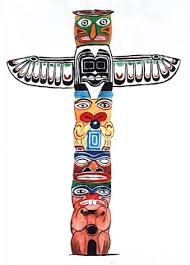
3. Totem: (an Algonquian language): An animal or natural object considered as being ancestrally realted to a given kin or descent group taken as it's symbol (a symbol, especially one held in high regard).
Ex: A Totem pole:
4. Trickster: A person who tricks; cheat (tricksy: full of tricks; playful; mischievous).
5. Vision Quest: A rite of passage in some Native American cultures; the ceremony is one of the most universal and ancient means to find spiritual guideance and purpose; can provide a deep understanding of one's life purpose.
6. Divination: The art or practice that seeks to forsee or fortell future events or discover hidden knowledge usually by the interpretation of omens or by the aid of supernatural powers; unusual insight: intuitive perception.
Ex: The art of reading tea leaves:


7. Pantheism: The belief that everything composes an all- encompassing, immanent God, or that the Universe (or nature) is identical with divinity.
8. Polytheism: The belief in multiple gods.
9. Monotheism: the belief in the existence of one god or in the oneness of God; the belief in one personal and transcendent God.
Ex: The God shared by the religions of Christianity, Islam, and Judaism:
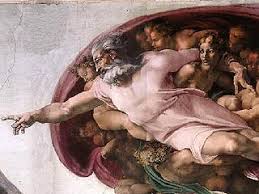
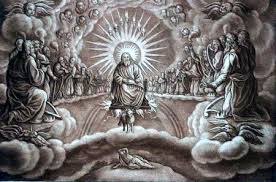
10. Revelation (in religious context): The revealing or disclosing of some form of truth through supposed communication with a deity or other supernatural entity or entities.
Ex: The Revelation of St. John:
11. Transcendence: abstract, meta- physical. In Katian philosophy, based on those elements of experience which derive not from sense data, but from the inherent organizing function of the mind, and which are the necessary conditions of human knowledge; trancending sense experience but not knowledge.
12. Empathy: The projection of one's own personality into the personality of another in order to understand the person better; ability to share in another's emotions, thoughts, or feelings.
Ex:
2. Taboo: A system of social ordering that dictates that specific objects and activities, owing to their sacred nature, are set aside for specific groups and are strictly forbidden to others; common to many primal peoples, including the Australian Aborigines; A Polynesian language (among some Polynesian peoples, a sacred prohibition put opon certain people, things or acts which makes them untouchable, unmentionable, etc.).
3. Totem: (an Algonquian language): An animal or natural object considered as being ancestrally realted to a given kin or descent group taken as it's symbol (a symbol, especially one held in high regard).
Ex: A Totem pole:
4. Trickster: A person who tricks; cheat (tricksy: full of tricks; playful; mischievous).
5. Vision Quest: A rite of passage in some Native American cultures; the ceremony is one of the most universal and ancient means to find spiritual guideance and purpose; can provide a deep understanding of one's life purpose.
6. Divination: The art or practice that seeks to forsee or fortell future events or discover hidden knowledge usually by the interpretation of omens or by the aid of supernatural powers; unusual insight: intuitive perception.
Ex: The art of reading tea leaves:
7. Pantheism: The belief that everything composes an all- encompassing, immanent God, or that the Universe (or nature) is identical with divinity.
8. Polytheism: The belief in multiple gods.
9. Monotheism: the belief in the existence of one god or in the oneness of God; the belief in one personal and transcendent God.
Ex: The God shared by the religions of Christianity, Islam, and Judaism:
10. Revelation (in religious context): The revealing or disclosing of some form of truth through supposed communication with a deity or other supernatural entity or entities.
Ex: The Revelation of St. John:
11. Transcendence: abstract, meta- physical. In Katian philosophy, based on those elements of experience which derive not from sense data, but from the inherent organizing function of the mind, and which are the necessary conditions of human knowledge; trancending sense experience but not knowledge.
12. Empathy: The projection of one's own personality into the personality of another in order to understand the person better; ability to share in another's emotions, thoughts, or feelings.
Friday, January 4, 2013
Extra Credit Movie Essay- Reflection
Extra Credit Movie Reflection
Alfred Hitchcock: “I Confess”
2. Why did the priest remain faithful to his vow to never
reveal anything from a confession when it would have been easier on him to just
reveal the information? What does the movie's resolution at the end demonstrate
Hitchcock's own view of God? How would you have ended the movie? (15 points,
300-400 words)
In Alfred Hitchcock’s film “I Confess”, Father Logan
remained faithful to his vow never to reveal anything from a confession.
Personally, I believe that there are several reasons as to why he would’ve done
this. He did not want to break the sacred bonds of confession, due to the fact
that he had very strong beliefs in the vows that he took when he was ordained
as a priest. In the sacrament of Reconciliation (Confession), a priest must not
reveal the sins that have been expressed to him. He is bound by his oath and the vows that he
took when he was ordained, and if he had broken them, it would be an infringement
on his accreditation as a priest.
At the end of the movie, Hitchcock uses imagery, as with his
other works as well, to send a message to the audience. For example, during
Father Logan’s trial, the Church’s bells were ringing. This could’ve symbolized
the approaching “doom” for the Father, as he was very close to being found
guilty. The bells could also symbolize the “doom for the truth”; as the film
draws to a close, the truth dawns on the people of the court. Similarly, as
most church bells symbolize a beginning or a start, they could also symbolize
the beginning of the truth, when they discover that Father Logan is innocent.
Another symbol is the Crucifix that Hitchcock places on the
wall of the courthouse. It is not only suggesting the priest’s relationship to
God, but also the relationship between God and the court. By having the cross
hang on the wall above the jury’s heads, Hitchcock could be hinting at the
pressure that was placed upon the jury, due to the fact that it was a priest
that they were accusing. I also think that Hitchcock could have been saying
that Father Logan’s trial is very similar to Jesus’. The Crucifix is hanging on
the wall almost waiting to bring him to his fate. As the jury had the ability
to decide whether or not Father Logan was guilty or innocent, they held the
power to condemn him to death (because if he was found guilty, Logan too would
be sentenced to death as any other murderer). In this way, with Logan’s trial
under the jury and Jesus’ under Pontius Pilate, and both are wrongly accused
and innocent, Hitchcock could have been drawing distinct similarities between
Father Logan, (as a priest, a representative for God on earth) and Jesus, the
true God. Also, by placing it directly over the jury, Hitchcock could also be
the weight of the decision that is placed on the jury (just as Jesus had to
bear the weight of the cross, the jury has to carry the burden of deciding
Father Logan’s future).
Sunday, December 16, 2012
Mid- Term Review
Introductory Unit:
1.) Heart- the center of the human person; where all your desires work; where all your decisions are made; ("Locus of the person")
2.) Desire- the nature of existence (can only be answered by something external.)
3.) Reality- the state of things as they actually exist.
4.) 4 Truths of the "I":
-I did not make myself
-We all have desires that are unlimited (we all want things)
-We are limited (our abilities are limited)
-We expect to be happy.
5.) Religious Sense- a factual issue to which the human heart is naturally predisposed.
6.) Ontology- reason, sense, meaning (ontos = "being")
7.) Being- existence
Anointing of the Sick:
1.) Suffering- the bearing of pain or distress.
2.) Original Sin- Sin that all humans are born with due to the first sin of Adam and Eve, that broke the beautiful bond between God and humans.
3.) History of the sick being healed by the Church:
-ex: In the Bible, it tells of Jesus curing the blind and deaf, and healing those with Leprosy.
4.) Who administers the sacrament?
- A priest or decon
5.) Who can recieve the sacrament?
- Anyone who is gravely ill and in danger of dying, and who requests for the sacrament to be administered to them.
6.) Celebration of the Sacrament- it is preformed when one is very ill and in danger of dying.
7) Four main effects of the sacrament:
- Union with the Passion of Christ
- Grace to prepare for their meeting with God
- Fortitude
- Forgiveness of sins (aid in the salvation of their soul).
Reconciliation:
1.) Penance- repentance of sins
2.) Confession- the means by which God forgives sins after Baptism
3.) Ten Commandments- the commandments, or ten rules that God gave to the human people. (These include not having any other gods before him, the one true God (1), not taking the Lord's name in vain (2), Keeping holy the Sabbath Day (3), Honoring thy father and mother (4), etc.).
4.) Absolution- forgiveness of your sins
5.) Mortal Sin- a willful rejection of a perfect realtion with God.
6.) Original Sin- Sin that all humans are born with due to the first sin of Adam and Eve, that broke the beautiful bond between God and humans.
7.) Personal Sin- the source of social sin
8.) Who forgives sin?
- God alone.
9.) What is the role of the priest?
- The priest acts as a representative for God during Confession.
10.) How often should one attend confession?
- A practicing Catholic is asked to atend confession at least once a year.
Matrimony:
1.) Abortion- the direct and purposeful taking of the life of the unborn child.
2.) Annulment- a finding that there was only a putative marriage under canon law.
3.) Purpose of Marriage- procreation
4.) Natural Family Planning- approved method of family planning for Christians.
5.) Grace- a supernatural push or encouragement
6.) Domestic Church- religious family
7.) Creation- the concept that matter comes from God.
Holy Orders:
1.) Diocese- the district or see under the supervision of a bishop.
2.) Vicar- representative, deputy or substitute
3.) Synod of Bishops- an advisory body for the Pope
4.) Ecumenical Council- a conference of ecclesiastical dignitaries and theological experts convened to discuss and settle matters of Church doctrine and practice.[
5.) Infallibility- the belief that the Holy Spirit will not allow the Church to err in its belief or teaching under certain circumstances.
6.) Parish- the lowest ecclesiastical geographical subdivision (diocese, deanery, parish)
7.) Stole- A narrow band of silk or stuff, sometimes enriched with embroidery and jewels, worn on the left shoulder of deacons, and across both shoulders of bishops and priests.
Baptism:
1.) Definition- the rite of adoption of someone into the Christian Church.
2.) Proper Matter- (flowing) water
3.) Correct Words/ Form:
-"I baptize you in the name of the Father, and of the Son, and of the Holy Spirit" with triple pour of water.
4.) Designated Minister:
-Bishop, Priest ofr Decon (in emergency anyone who intends to offer Baptism).
5.) Cradle vs. Convert- Someone who is baptized as a baby and who does not have the ability to choose for themselves, versus someone who wants to enter into the Catholic Church as an adult.
6.) White Garment:
-Symbolizes the purity of the Spirit as it enters into you at Baptism.
7.)Water:
-Symbolizes the cleansing of Original Sin.
Confirmation:
1.)Definition- the sacrament the "completes Baptism"; you become an adult in the church, by reaffirming your Baptismal promises.
2.)Proper Matter:
-Anionting with Chrism
3.)Correct Words/ Form:
- "Be sealed with the gift of the Holy Spirit" with oil on the forehead in the sign of the Cross.
4.)Designated Minister:
- Bishop
5.)Seal:
-Oil on forehead
6.) Holy Spirit- the guideance of God for humans on Earth.
7.) Gifts of the Holy Spirit- Gifts that the Holy Spirit brings upon the newly confirmed:
- Wisdom
-Understanding
- Right Judgement
-Knowledge
-Courage
-Reverence
-Wonder and Awe
Eucharist:
1.) Consecration- The act of blessing the bread and wine, and God transforming it into the body and blood of his son, Jesus Christ (as he showed his Apostles and Disciples at the Last Supper).
2.)Transubstantiation- the act of the bread and wine transforming into the body and blood of Jesus.
3.) Other names for the Eucharist- Holy Communion
4.) Biblical Basis- Sacrifice to God (they would slaughter a goat on an altar as a sacrifice to God, however after Jesus came, he showed them the perfect sacrifice that we could make to God: the sacrifice of his own son, Jesus- his body and blood, which we offer up to him at mass).
5.) Proper Matter:
-Wheat based Bread and pure grape wine.
6.) Correct Words/ Form:
-The words of Institution: "This is my body.... This is the chalice of my blood..."
7.) Designated Minister:
-Bishop or Priest
1.) Heart- the center of the human person; where all your desires work; where all your decisions are made; ("Locus of the person")
2.) Desire- the nature of existence (can only be answered by something external.)
3.) Reality- the state of things as they actually exist.
4.) 4 Truths of the "I":
-I did not make myself
-We all have desires that are unlimited (we all want things)
-We are limited (our abilities are limited)
-We expect to be happy.
5.) Religious Sense- a factual issue to which the human heart is naturally predisposed.
6.) Ontology- reason, sense, meaning (ontos = "being")
7.) Being- existence
Anointing of the Sick:
1.) Suffering- the bearing of pain or distress.
2.) Original Sin- Sin that all humans are born with due to the first sin of Adam and Eve, that broke the beautiful bond between God and humans.
3.) History of the sick being healed by the Church:
-ex: In the Bible, it tells of Jesus curing the blind and deaf, and healing those with Leprosy.
4.) Who administers the sacrament?
- A priest or decon
5.) Who can recieve the sacrament?
- Anyone who is gravely ill and in danger of dying, and who requests for the sacrament to be administered to them.
6.) Celebration of the Sacrament- it is preformed when one is very ill and in danger of dying.
7) Four main effects of the sacrament:
- Union with the Passion of Christ
- Grace to prepare for their meeting with God
- Fortitude
- Forgiveness of sins (aid in the salvation of their soul).
Reconciliation:
1.) Penance- repentance of sins
2.) Confession- the means by which God forgives sins after Baptism
3.) Ten Commandments- the commandments, or ten rules that God gave to the human people. (These include not having any other gods before him, the one true God (1), not taking the Lord's name in vain (2), Keeping holy the Sabbath Day (3), Honoring thy father and mother (4), etc.).
4.) Absolution- forgiveness of your sins
5.) Mortal Sin- a willful rejection of a perfect realtion with God.
6.) Original Sin- Sin that all humans are born with due to the first sin of Adam and Eve, that broke the beautiful bond between God and humans.
7.) Personal Sin- the source of social sin
8.) Who forgives sin?
- God alone.
9.) What is the role of the priest?
- The priest acts as a representative for God during Confession.
10.) How often should one attend confession?
- A practicing Catholic is asked to atend confession at least once a year.
Matrimony:
1.) Abortion- the direct and purposeful taking of the life of the unborn child.
2.) Annulment- a finding that there was only a putative marriage under canon law.
3.) Purpose of Marriage- procreation
4.) Natural Family Planning- approved method of family planning for Christians.
5.) Grace- a supernatural push or encouragement
6.) Domestic Church- religious family
7.) Creation- the concept that matter comes from God.
Holy Orders:
1.) Diocese- the district or see under the supervision of a bishop.
2.) Vicar- representative, deputy or substitute
3.) Synod of Bishops- an advisory body for the Pope
4.) Ecumenical Council- a conference of ecclesiastical dignitaries and theological experts convened to discuss and settle matters of Church doctrine and practice.[
5.) Infallibility- the belief that the Holy Spirit will not allow the Church to err in its belief or teaching under certain circumstances.
6.) Parish- the lowest ecclesiastical geographical subdivision (diocese, deanery, parish)
7.) Stole- A narrow band of silk or stuff, sometimes enriched with embroidery and jewels, worn on the left shoulder of deacons, and across both shoulders of bishops and priests.
Baptism:
1.) Definition- the rite of adoption of someone into the Christian Church.
2.) Proper Matter- (flowing) water
3.) Correct Words/ Form:
-"I baptize you in the name of the Father, and of the Son, and of the Holy Spirit" with triple pour of water.
4.) Designated Minister:
-Bishop, Priest ofr Decon (in emergency anyone who intends to offer Baptism).
5.) Cradle vs. Convert- Someone who is baptized as a baby and who does not have the ability to choose for themselves, versus someone who wants to enter into the Catholic Church as an adult.
6.) White Garment:
-Symbolizes the purity of the Spirit as it enters into you at Baptism.
7.)Water:
-Symbolizes the cleansing of Original Sin.
Confirmation:
1.)Definition- the sacrament the "completes Baptism"; you become an adult in the church, by reaffirming your Baptismal promises.
2.)Proper Matter:
-Anionting with Chrism
3.)Correct Words/ Form:
- "Be sealed with the gift of the Holy Spirit" with oil on the forehead in the sign of the Cross.
4.)Designated Minister:
- Bishop
5.)Seal:
-Oil on forehead
6.) Holy Spirit- the guideance of God for humans on Earth.
7.) Gifts of the Holy Spirit- Gifts that the Holy Spirit brings upon the newly confirmed:
- Wisdom
-Understanding
- Right Judgement
-Knowledge
-Courage
-Reverence
-Wonder and Awe
Eucharist:
1.) Consecration- The act of blessing the bread and wine, and God transforming it into the body and blood of his son, Jesus Christ (as he showed his Apostles and Disciples at the Last Supper).
2.)Transubstantiation- the act of the bread and wine transforming into the body and blood of Jesus.
3.) Other names for the Eucharist- Holy Communion
4.) Biblical Basis- Sacrifice to God (they would slaughter a goat on an altar as a sacrifice to God, however after Jesus came, he showed them the perfect sacrifice that we could make to God: the sacrifice of his own son, Jesus- his body and blood, which we offer up to him at mass).
5.) Proper Matter:
-Wheat based Bread and pure grape wine.
6.) Correct Words/ Form:
-The words of Institution: "This is my body.... This is the chalice of my blood..."
7.) Designated Minister:
-Bishop or Priest
Thursday, December 6, 2012
A Universal Call to Holiness
In one of his several addresses to the Catholic Community, Monsignor Guissiani uses a quote from T.S. Elliot to describe how the Catholic Church and mankind have equally failed each other. In Elliot's quote, he states that: "if I need something, I chase after it if it goes away." We keep pushing God's call to us aside, as our everyday lives rush by. We are putting off the call to holiness by the fact that we always see that the present time is in fact the wrong time to respond to his call. We see other things as more or equally as important, and we tend to place those things above him. However, along with our physical and mental sluggishness, which makes us lax in this area, it is the fact only caused by the “but [also] the interior sluggishness of our hearts.” As the author Seghers presents in his article, “We [all Christians] need to be clear that there will never be a better time or a better set of circumstances than now to respond wholeheartedly to the call to holiness.” He goes on to say that "now is the acceptable time", and that "the very things that we falsely judge as obstacles are the very means God gives us to draw us to surrender more deeply on Him."
I personally believe that this quote implies for the everyday Catholic to "not be discouraged by by these painful moments of our transformation but to accept that they're a necessary and blessed part of the whole process." "It is essential for all those who want to spend eternity with God." It says in the Bible, (John, Ch 15:5), that "Without [him], we can do nothing. Without God, sucessfully completing the journey is impossible, but with Him, in a sense, we are already there."
I believe that by "say[ing] who Christ is" without shame, we fully declare ourselves as Christians, and by doing this we are finally accepting his call and his will for us. When we are ashamed to accept him, we are not only rejecting God and all of his great works, but we are failing to fulfill the vows that we promised, and agreed to, both at Baptism and Confirmation.
Jim Segher, the author of The Call to
Holiness, notes that: “an intimate union with God is possible in this
life for everyone who will surrender to it, and work toward it with God’s grace.” As we [the Christians of the world] seek the perfect union with God, we only need to accept his will for us, and be constantly pursuing this call.
Sunday, November 4, 2012
Grace and Justification- Distance Learning #1
For the first date, in the Catechism of the Catholic Church's article on Grace and Justification, it discusses how "the grace of the Holy Spirit has the power to justify us", and how it cleanes us of our sins. It "communicates to us 'the righteousness of God through faith in Jesus Christ' and through Baptism". This is reflected in Flannery O'Connor's short story "The River", in the sense that the young boy in the story is Baptized, and therefore cleansed.
Also, one example of the second date in the story, is that the emotion that the young boy, Harry, feels when he is baptized by the pastor in the river, is almost overwelming to him. As he listens to the pastor's words, he begins to realize that he truly matters to God. In the story, the author suggests that given Harry's home life, he probably does not get much attention, or is told how important he is, or how much he matters to the world.
The article also describes how "the first work of the grace of the Holy Spirit is conversion" (for the third date). This is demonstrated in the story, when the boy (Harry, who claimed his name was Bevel), who is baptized, and enters into the Church. He feels the water in the River change him, and even though he is only five years old, he knows that he wants to be a bigger part of it. He returned to the river at the end of the story, because he wanted to be able to be a part of something larger than himself, and he had, for probably the first time in his life, realized that he actually mattered to someone, God.
For the fourth date that the article mentions (1990), it states that "Justification detaches man from sin, which contradicts the love of God". This reflects on the young boy's conversion in the river, with the Pastor. He feels God's love, and is completely overwhelmed by the prospect of it. He is only five years old, and he understands more than most adults about the power of the Holy Spirit in the Sacrament of Baptism. While he might not fully understand the true meaning of those words, he knows by his experience when he was in the River, that there is something remarkable about the water, and how it had cleansed him of his sins. It also mentions that "it reconciles man with God". This is a perfect example of how the boy felt after he was baptized by the preacher. Also, in his prayer before the baptism, the priest mentions that the "waters heal, and it frees us from the enslavement of sin".
The next two dates, (1991 and 1992), discusses "the acceptance of God's righteousness through faith in Jesus Christ", and how "Justification has been merited for us by the Passion of Christ". This is demonstrated in the story, through the fact that the pastor was discussing the cleansing of original sin, and how it represents you coming into the church, and into God's life.
The last three dates that deal with Justification, (1993, 1994 and 1995), it states that "Justification establishes cooperation between God's grace and man's freedom". it is also the "most excellent work of God's love made manifest in Christ." These are both demonstrated in the story through the fact that after the young boy is Baptized, he mentions that he feels free, and that is due to the fact that he is now cleansed of his sin.
The other important factor in the article is Grace. It states in the first date, 1996, that " our Justification comes from the grace of God". This is clearly represented in the short story, "The River", by the fact that "Grace is favor". He gives us grace and help through the sacrament of baptism. In the story, he helps the young boy understand that God gives us grace and help, especially afterwards, when he has to return home.
The other dates, (from 1997, 1998, and 1999), also directly relate to the story. The article from 1997 states that "grace is a participation in the life of God". This reflects on the story in the sense that the boy, Harry, feels (for once) that he matters. Although he is hesitant, he allows them to baptize him in the river, and afterward, he realizes the importance of sacrament. It also discusses how "the vocation to eternal life is supernatural". Only God alone can reveal himself to us. The young boy in the story is so longing to be a part of that, and to finally see the kingdom of God, which promises everlasting love and happiness, that he returns to the river at the end of the story.
In 2000, it stated that "santifying grace is a habitual gift" It "perfects the soul itself to enable it to live with God". This is represented in the story by the fact that in Baptism, it also perfects the soul. It enables your soul to be ready for the person's new life with God on Earth. Also, it prepares us for the reception of grace, because by receiving the sacrament of Baptism, we are also receiving God's grace(which was stated in the 2001 article). The young boy's parents do not experience this, because not only were they not baptized, but they do not even display grace towards their son. In order for us to receive God's grace, we have to also display grace to others, around us, as described in the article from 2002. Also in the article from 2002, it describes "man's free response", which is demonstrated in the story when Harry, decides to return to the river, after his Baptism.
In 2003, they stated that "Grace is first and foremost the gift of the Spirit who justifies and sanctifies us". This also includes "sacramental graces", which are gifts that relate to the different sacraments, such as Baptism. This is reflected in the story, when the preacher is telling Bevel (Harry) about the sacrament of Baptism, when he is being Baptized in the river.
For 2004, it discusses how "among the special graces, are 'graces of state' that accompany the other responsibilities of the Christian life". In "The River", Bevel learns these graces, as he is being Baptized, and is beginning a new life in the church. In 2005, they stated that "grace escapes our experience" and that it "cannot be known except by faith". Bevel learns this, as he is so longing for grace, and the justification that he really matters. After he is baptized, he feels so strongly about the river's and God's power, that he wants to be entirely consumed by it. He wants to always be a part of it and in the end he is.
Also, one example of the second date in the story, is that the emotion that the young boy, Harry, feels when he is baptized by the pastor in the river, is almost overwelming to him. As he listens to the pastor's words, he begins to realize that he truly matters to God. In the story, the author suggests that given Harry's home life, he probably does not get much attention, or is told how important he is, or how much he matters to the world.
The article also describes how "the first work of the grace of the Holy Spirit is conversion" (for the third date). This is demonstrated in the story, when the boy (Harry, who claimed his name was Bevel), who is baptized, and enters into the Church. He feels the water in the River change him, and even though he is only five years old, he knows that he wants to be a bigger part of it. He returned to the river at the end of the story, because he wanted to be able to be a part of something larger than himself, and he had, for probably the first time in his life, realized that he actually mattered to someone, God.
For the fourth date that the article mentions (1990), it states that "Justification detaches man from sin, which contradicts the love of God". This reflects on the young boy's conversion in the river, with the Pastor. He feels God's love, and is completely overwhelmed by the prospect of it. He is only five years old, and he understands more than most adults about the power of the Holy Spirit in the Sacrament of Baptism. While he might not fully understand the true meaning of those words, he knows by his experience when he was in the River, that there is something remarkable about the water, and how it had cleansed him of his sins. It also mentions that "it reconciles man with God". This is a perfect example of how the boy felt after he was baptized by the preacher. Also, in his prayer before the baptism, the priest mentions that the "waters heal, and it frees us from the enslavement of sin".
The next two dates, (1991 and 1992), discusses "the acceptance of God's righteousness through faith in Jesus Christ", and how "Justification has been merited for us by the Passion of Christ". This is demonstrated in the story, through the fact that the pastor was discussing the cleansing of original sin, and how it represents you coming into the church, and into God's life.
The last three dates that deal with Justification, (1993, 1994 and 1995), it states that "Justification establishes cooperation between God's grace and man's freedom". it is also the "most excellent work of God's love made manifest in Christ." These are both demonstrated in the story through the fact that after the young boy is Baptized, he mentions that he feels free, and that is due to the fact that he is now cleansed of his sin.
The other important factor in the article is Grace. It states in the first date, 1996, that " our Justification comes from the grace of God". This is clearly represented in the short story, "The River", by the fact that "Grace is favor". He gives us grace and help through the sacrament of baptism. In the story, he helps the young boy understand that God gives us grace and help, especially afterwards, when he has to return home.
The other dates, (from 1997, 1998, and 1999), also directly relate to the story. The article from 1997 states that "grace is a participation in the life of God". This reflects on the story in the sense that the boy, Harry, feels (for once) that he matters. Although he is hesitant, he allows them to baptize him in the river, and afterward, he realizes the importance of sacrament. It also discusses how "the vocation to eternal life is supernatural". Only God alone can reveal himself to us. The young boy in the story is so longing to be a part of that, and to finally see the kingdom of God, which promises everlasting love and happiness, that he returns to the river at the end of the story.
In 2000, it stated that "santifying grace is a habitual gift" It "perfects the soul itself to enable it to live with God". This is represented in the story by the fact that in Baptism, it also perfects the soul. It enables your soul to be ready for the person's new life with God on Earth. Also, it prepares us for the reception of grace, because by receiving the sacrament of Baptism, we are also receiving God's grace(which was stated in the 2001 article). The young boy's parents do not experience this, because not only were they not baptized, but they do not even display grace towards their son. In order for us to receive God's grace, we have to also display grace to others, around us, as described in the article from 2002. Also in the article from 2002, it describes "man's free response", which is demonstrated in the story when Harry, decides to return to the river, after his Baptism.
In 2003, they stated that "Grace is first and foremost the gift of the Spirit who justifies and sanctifies us". This also includes "sacramental graces", which are gifts that relate to the different sacraments, such as Baptism. This is reflected in the story, when the preacher is telling Bevel (Harry) about the sacrament of Baptism, when he is being Baptized in the river.
For 2004, it discusses how "among the special graces, are 'graces of state' that accompany the other responsibilities of the Christian life". In "The River", Bevel learns these graces, as he is being Baptized, and is beginning a new life in the church. In 2005, they stated that "grace escapes our experience" and that it "cannot be known except by faith". Bevel learns this, as he is so longing for grace, and the justification that he really matters. After he is baptized, he feels so strongly about the river's and God's power, that he wants to be entirely consumed by it. He wants to always be a part of it and in the end he is.
Saturday, November 3, 2012
"The Man Without a Face"- Reflection
In the beginning of the movie, “The Man Without A
Face”, the main character, Charles Norstadt is hesitant to approach Mel Gibson’s
character. Although he wants to learn from him, so he can pass his test, he is
doubtful about asking the man for help. Mainly due to the rumors about McLeod,
and his outward appearance (the scarring on his face), Norstadt is hesitant
about taking lessons from him. Eventually, he grows to know and trust McLeod
(Mel Gibson), through his personal experiences, with McLeod teaching him. However,
in the beginning, McLeod is also a little hesitant to teach Norstadt, due to the normal reactions of people, when they see his face. Also, he wants to know that Norstadt will actually complete the work that McLeod assigns to him. He wants to know that his efforts will not be wasted on Norstadt. After McLeod agrees, he makes Charles
dig holes on his property.
At first, Norstadt was upset. He saw it as a waste of time and effort on his part. However, this action, which seemed pointless to Norstadt, proved to McLeod that Norstadt could follow his orders and advice, as an important part of every relationship is obedience. If Norstadt refused to listen to McLeod, then it would be very difficult for McLeod to teach him effectively.
McLeod also did not force Norstadt to come everyday to his house to study or be taught, because his freedom was very important to his accepting McLeod. McLeod expresses to Nordstadt that he has the freedom to choose whether to come, because he understands that it is important for Norstadt to accept him on his own terms. He did not want to force Norstadt to believe anything that he did not truly see on his own. Rather than viewing McLeod as simply crazy, as he and so many others had previously believed, Norstadt’s free will enabled him see McLeod, as he truly was.
It is equally important to McLeod that Norstadt use his own freedom to decide if the rumors concerning McLeod are true. If McLeod is going to be teaching him then he wants to be sure that Norstadt can decide on his own if McLeod is a trustworthy person, regardless of what the rumors might suggest. It also proves to McLeod that Norstadt trusts him, and could bring him the certainty that he needs, after the citizens of the town have ignored him, for so many years after the accident.
At the end of the movie, the main character, Norstadt, was morally certain of McLeod. In order to become morally certain of a person, it requires experiences with that person. While learning how to pass the exam, Norstadt also learned about McLeod’s past, and with this, he grew certain of McLeod. He was able to finally reach the conclusion that while the rumors about McLeod seemed true, they did not at all reflect on McLeod’s true nature.
At first, Norstadt was upset. He saw it as a waste of time and effort on his part. However, this action, which seemed pointless to Norstadt, proved to McLeod that Norstadt could follow his orders and advice, as an important part of every relationship is obedience. If Norstadt refused to listen to McLeod, then it would be very difficult for McLeod to teach him effectively.
McLeod also did not force Norstadt to come everyday to his house to study or be taught, because his freedom was very important to his accepting McLeod. McLeod expresses to Nordstadt that he has the freedom to choose whether to come, because he understands that it is important for Norstadt to accept him on his own terms. He did not want to force Norstadt to believe anything that he did not truly see on his own. Rather than viewing McLeod as simply crazy, as he and so many others had previously believed, Norstadt’s free will enabled him see McLeod, as he truly was.
It is equally important to McLeod that Norstadt use his own freedom to decide if the rumors concerning McLeod are true. If McLeod is going to be teaching him then he wants to be sure that Norstadt can decide on his own if McLeod is a trustworthy person, regardless of what the rumors might suggest. It also proves to McLeod that Norstadt trusts him, and could bring him the certainty that he needs, after the citizens of the town have ignored him, for so many years after the accident.
At the end of the movie, the main character, Norstadt, was morally certain of McLeod. In order to become morally certain of a person, it requires experiences with that person. While learning how to pass the exam, Norstadt also learned about McLeod’s past, and with this, he grew certain of McLeod. He was able to finally reach the conclusion that while the rumors about McLeod seemed true, they did not at all reflect on McLeod’s true nature.
Subscribe to:
Posts (Atom)